

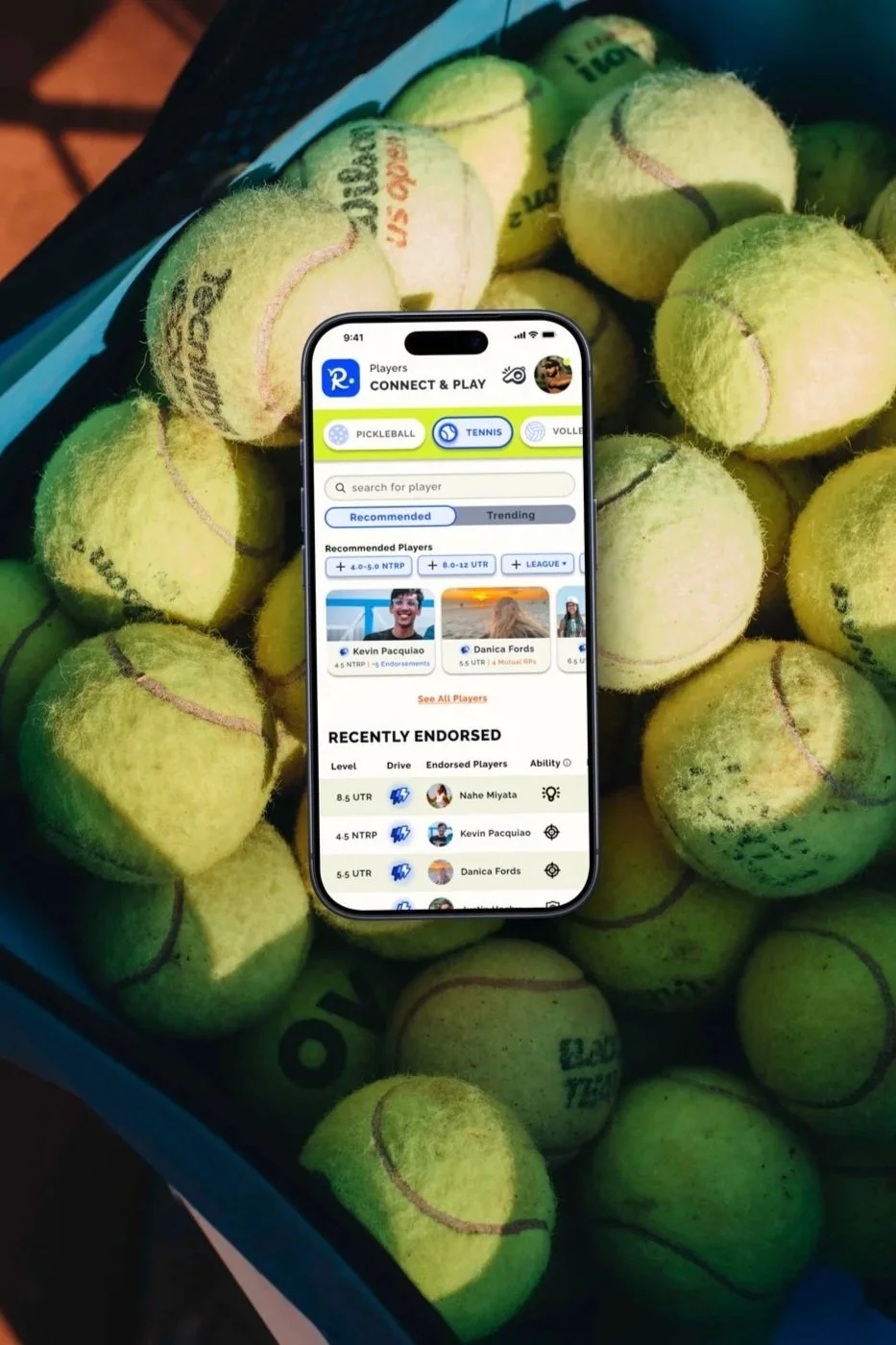
Players making better players.
Rally is an app designed to support recreational adult athletes of all levels, drive skill development through peer recognition and bridge organic connections through shared competitive interests.
Inspired by the idea of a rewarding rally between you and another player.
Project Context
7 month span. I was the primary UX researcher and UI designer, responsible for key deliverables such as:
Foundational Research (Participant recruitment, user interviews, competitive analysis)
Research Synthesis (User personas, user scenarios, empathy maps, affinity mapping)
Information Architecture & Flows (User Flows, Key Feature Prioritization)
Testing & Iterations (Lo-fi wireframes, prototyping, user testing)
Branding (Logo, icons, brand style tile)
Final handoff (UI component set, final iterations, hi-fidelity prototype)
The Motivating Issue:
As someone reengaging with sports as an adult and dedicating 3-4 nights a week to recreational (rec) league games, I noticed a gap between two key groups of players: Lower Level/Less Experienced and Higher Level/More Experienced players.
Specifically, the lack of accessibility for less experienced players seeking higher levels of competition but feeling stunted due to limited opportunities to improve their game and to more experienced circles.
I set out to understand what incentivizes more experienced players to help less experienced players improve their skills and whether variables such as affordability and social dynamics affect a player’s competitive trajectory.
01.
The Warm up
Concept Foundation & Preliminary Research
Introduction
According to a 2025 Civic Science survey, 1 in 4 North American adults are interested in joining a new recreational sports league in the summer.
Since 2023, there has been a full 2-3 percentage point increase in certain motivational reasons for joining recreational adult sports. What was once sought after for personal enjoyment, general health and fitness has *pivoted to furthering skill development, competitive desire, and stress relief.
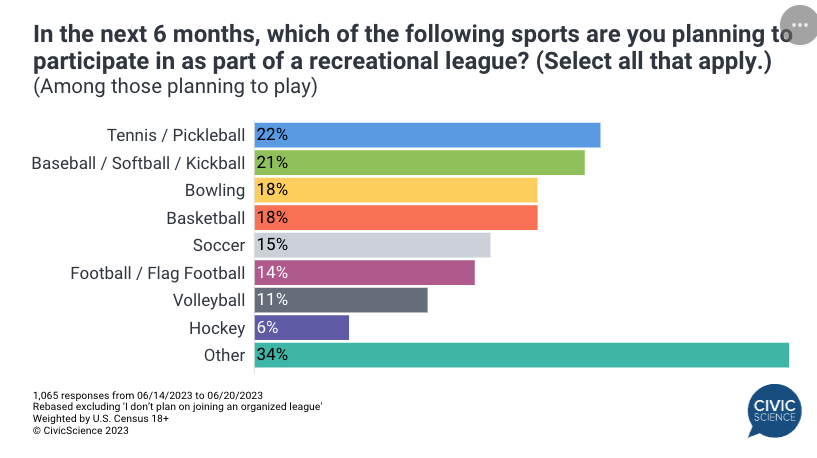
(Above) 2023 Civic Science survey, trending rec sports in adult leagues3 COMPOUNDING Factors
1. Culture Shift
As interest increases and motivations shift towards a more competitive mindset, the gap widens between less experienced athletes and those who developed the skills earlier.
2. Contrasting Needs
These circles don’t necessarily intersect within recreational leagues. Unfortunately, those who desire higher levels of competition, lack options for development.
3. Limited Options
Seeking professional help is typically expensive or unavailable. Weekly practices and games don’t prioritize intentional skill development.
Initial PROBLEM
How can recreational (rec) athletes successfully discover affordable, local opportunities to overcome skill plateaus and progress to higher levels of play?
02.
ANALYZING THE GAME
Building user research & counter-evidence verification
Research Overview
Research objectives set out to verify whether financial and social dynamics affect less-experienced (less-exp.) players’ pursuit of higher competition, and whether or not these also influenced more-experienced (more-exp.) players’ incentives to coach/help.
Methods:
In-person User Interviews
SWOT Analysis
Affinity Map
spoilers:
time and peer feedback for both player types were more influential than financial incentives/ affordability.
the nuanced finding was how much one’s self-perception actually influenced both player types to engage with one another.
-
Insight: Progress is gauged through external feedback (ie. ranks, tournaments, leagues, etc.) and proximity to certain social groups can speed up access to this feedback.
Redirection: Both types of players use external feedback and social groups to help gauge their level of progress.
Assumption #1
Assumption #2
-
Insight: Affordability is a factor, however a player’s self-perception on impacting the game or their team’s success is more influential when seeking coaching.
Redirection: Less-exp. players need to know where they can be most effective in order to pursue specific skills and enhance their competitive experience.
Assumption #3
-
Insight: Time investment and (similar to the less-exp. player) one’s perceived impact are more influential when it comes to helping other players improve their skills.
Redirection: More-exp. players need low-commitment opportunities to provide advice that doesn’t take away from their rec time.
Articulating expectations and achievable goals can make it easier for more-exp. players to offer timely, targeted support.
Both user groups shared similar values which helped prioritize the necessary features for Rally.
Feedback helps to establish clear expectations, set achievable goals, and lays the foundation for mutually beneficial partnerships.
Less-exp. players are motivated to pursue targeted areas of skill development and more-exp. players are provided with a clear understanding of their potential to help.
I value having other people’s opinions and rankings help…being able to have awareness where you fall.
Kelby, Beginner-Intermediate pickleball playerYou don’t want to come across as mean or a know-it-all...Maybe they don’t want help, so it’s kind of a question mark whether you step over that boundary.
Justin, Advanced indoor/sand volleyball player2. Understanding the impact of one’s influence to the game/player affects level of investment
When less-exp. players are aware of their potential to impact their team’s/personal game’s success they are more motivated to seek opportunities to improve their skills.
Likewise, when more-exp. players believe their advice will be received in an impactful way and progress is seen, they find value in their contribution.
If we just played on a women’s net I’d probably seek someone to teach me how to block, because then it’s beneficial…Once I knew I had potential, I tried harder.”

Cali, Beginner-Intermediate indoor volleyball playerI’m more likely to coach kids because you see a lot of improvement.
Atira, Advanced tennis player3. Time is a limited resource for both user groups, but when genuine social connections are made in combination with noticeable improvements, both groups feel time is well spent.
When less-exp. players are aware of their potential to impact their team’s/personal game’s success they are more motivated to seek opportunities to improve their skills.
Likewise, when more-exp. players believe their advice will be received in an impactful way and progress is seen, they see their investment as worthwhile and attribute value to the time invested.
Like day one you could just look around and see the people who knew their stuff…[Approaching Justin] It was easy…because it felt like we were friends already.

James, Beginner-Intermediate indoor volleyball playerI’m trying to build the community I want to be a part of, the barrier is just time management.
Justin, Advanced indoor/sand volleyball playerKey Player VALUES
REEVALUATE THE PROBLEM
Original Proposition:
How can rec athletes successfully discover affordable, local opportunities to overcome skill plateaus and progress to higher levels of play?
Research Adjusted:
How do we match less experienced players with more experienced players in ways that enhance rec competition through clear goals, peer feedback, and offer low-time commitments?
03.
Synthesizing data into user personas and features
A STARTING ROSTER
Defining personas & scenarios
User scenarios contextualized key user values, needs, and goals using stages to help formulate user flows. Both user groups were analyzed based off empathy maps and interview data.
Methods:
Empathy Maps
User Scenarios
User Personas
Key Areas of Definition
-
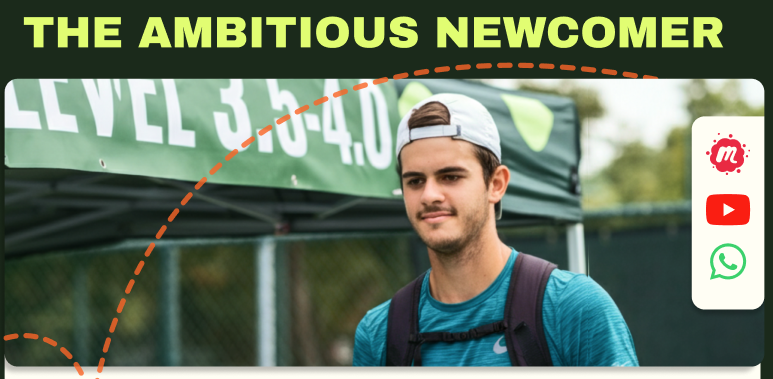
Less Experienced Players = The Ambitious Newcomer
(Beginner-Intermediate levels, new/returning to sport(s), Jr. High-High school level reached)
More Experienced Players = The Reluctant Mentor
(Advanced-Semi Professional Levels, former collegiate level, coach qualified) -
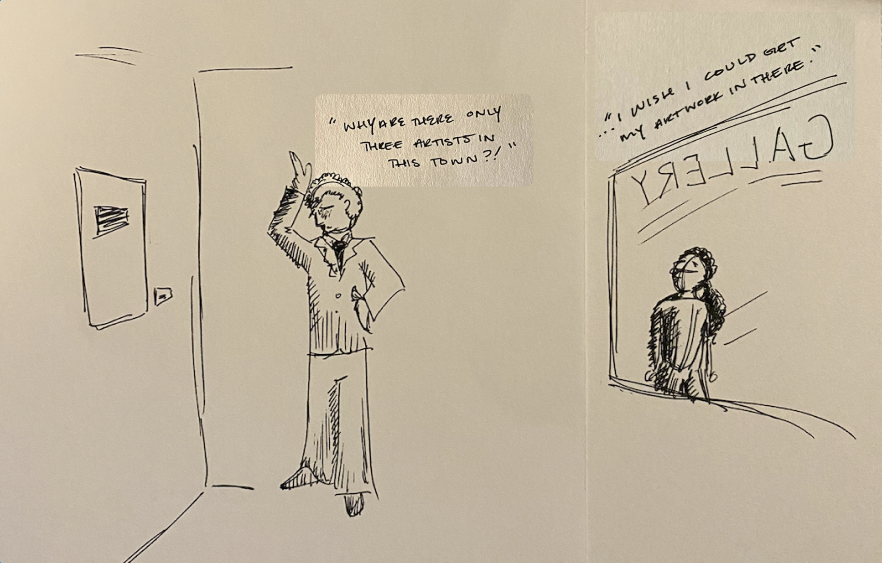
They hardly do. Accessibility vs. awareness dynamic.
“I knew volleyball [open gyms] ended in August and league starts. I want to be asked to play on the league team or be good enough for people to be like, ‘Oh! Her!””
- Atira F. (Beg-Int. volleyball player)
“There’s always room in advanced leagues..., it’s just getting people to that level.
A lot of advanced players don’t go to open gyms, [and] a lot of players at open gyms don’t know these people very well. It only allows for a very select few who get called to play [up].”
- Justin H. (A League, adv. volleyball player) -
Ambitious Newcomer: wants to gain entry into higher competitive levels and needs feedback from more experienced player(s) to accomplish this.
Reluctant Mentor: wants to broaden their competitive pool and needs the ability to discover potential players without requiring demanding commitments.
-
![]()
The Ambitious Newcomer, user persona inspired by less exp. players
-
![]()
Awareness vs. Accessibility, sketch by Erin Farrington ©️2025
-
![]()
User scenario & key stages, for less exp. player
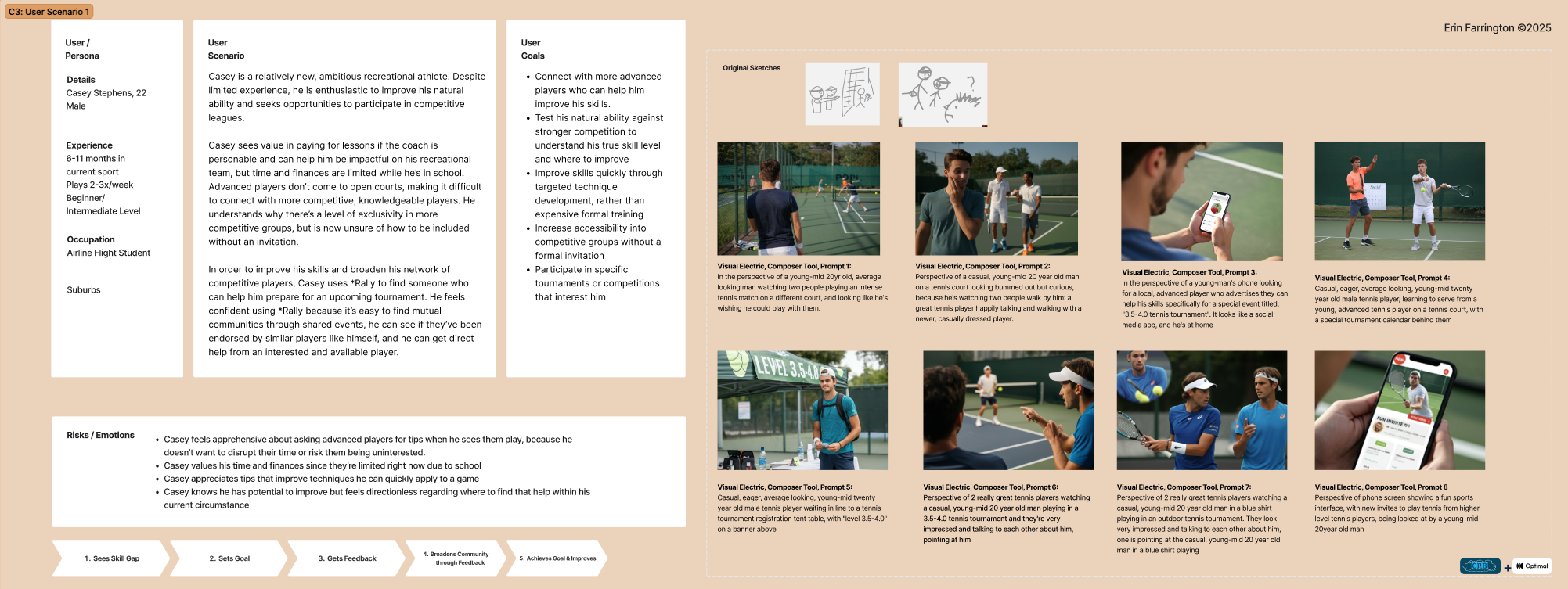
adjust for user-specific SCENARIOS
Research Adjusted Solution:
How do we match less experienced players with more experienced players in ways that enhance rec competition through clear goals, peer feedback, and offer low-time commitments?
User-Targeted Solution:
How might we create intersecting pathways to help rec athletes discover players outside their peer communities through shared goals, peer feedback,
and low-time commitments?
MUST HAVES:
Player Profiles/Recommendations
(See shared goals, low commitment discoverability)
Skill Endorsements/Leaderboards (Feedback, shared goals, low commitment discoverability)
Local Event Calendars (Shared goals, low commitment discoverability)
KEY FEATURES
Prioritized based off shared user needs and goals, inspired by preexisting areas of interaction vocalized in user interviews (WhatsApp, Facebook, open gyms, leagues, etc.).
NICE TO HAVES:
League-Building & Player Categories (Centralized space for player discoverability, “free agency/Need players”)
Activity Feeds/followers (promote more engagement between players, track progress)
In-app Messaging (User ease for quicker matchups, organization, and introductions)
SURPRISINGLY DELIGHTFUL:
Event-specific Coaching (Promoting mentorship, establishing clear goals and expectations.)
Player “Drive” (Player to player feedback, supports player evaluation for targeted discoverability and league recommendations)
04.
PUT INTO PLAY
Branding, lo-fi to hi-fi wireframes, initial prototypes

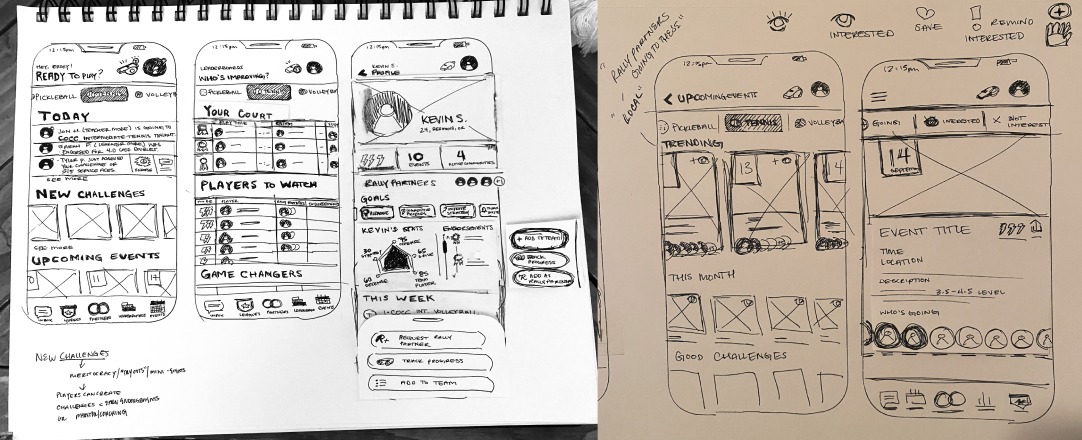
(Above) Lo-Fidelity wireframing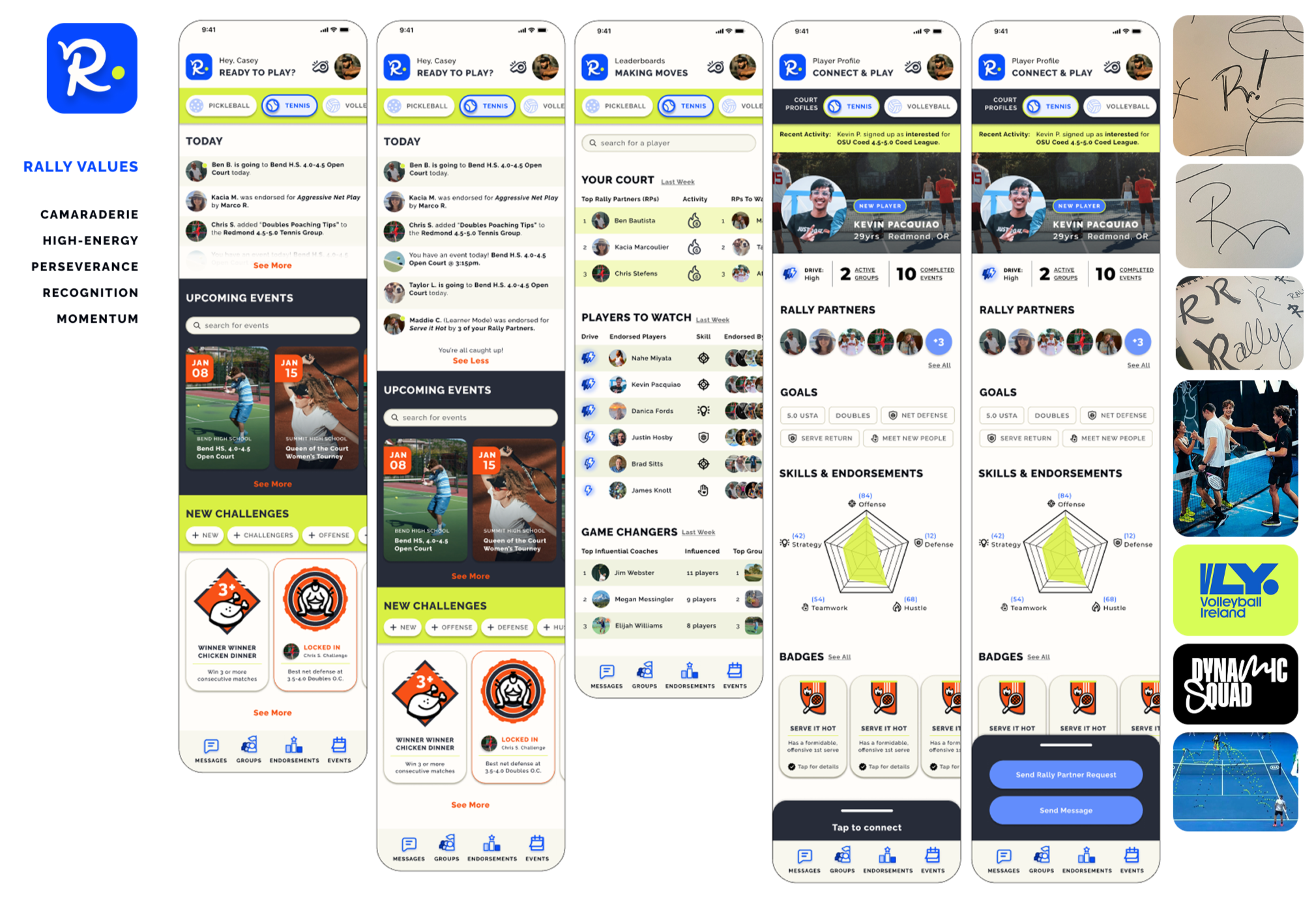
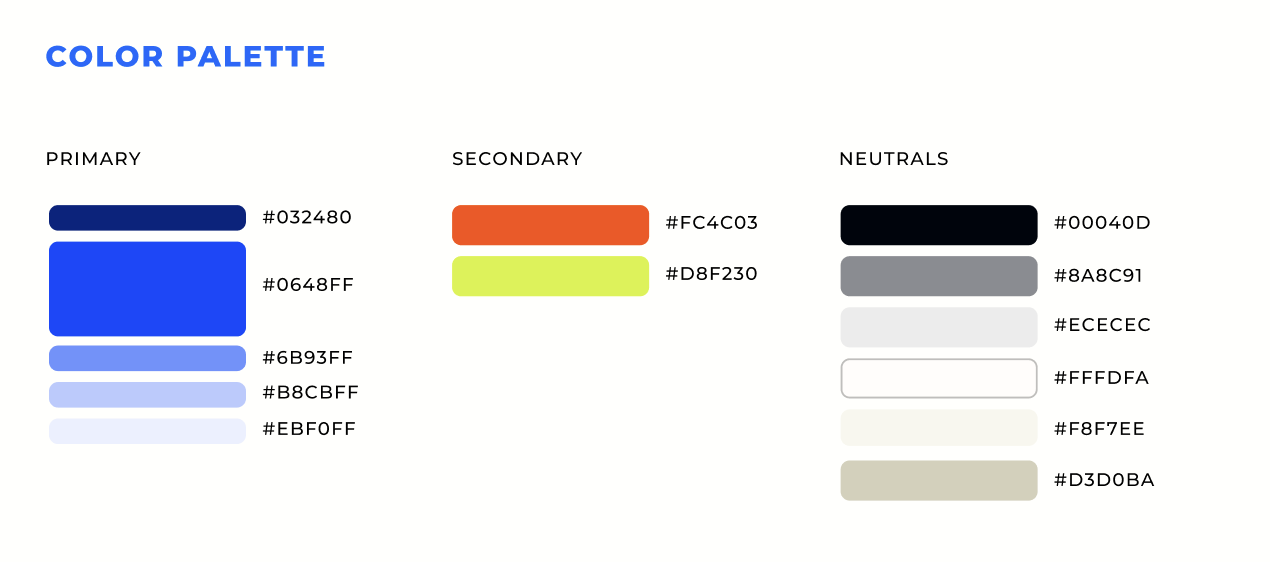
(Above) V1 Hi-Fidelity wireframes, iPhone 14 Plus screens 1.0-3.5 and branding elementsBrand Concept:
Rally is an app designed to support recreational adult athletes of all levels, drive skill development through peer recognition and bridge organic connections through shared competitive interests.
Inspired by the idea of a rewarding rally between you and another player.
To rally is to gather for a shared purpose.
A rally is a single point, fought in an exchange between two teams or players.
Rallying is also an inspiring term to keep the spirit of fun alive after a setback.
05.
Prototype testing & design iterations
Usability Testing
The specific task tested focused on The Reluctant Mentor persona seeking a new and qualified player to join his competitive tennis team. This required participants to fall under “High Intermediate-Advanced” level rec. players.
A click-through prototype tested five users on whether they could:
Discover an appropriate teammate for their advanced (4.5-5.0 NTRP) coed tennis rec team.
Navigate easily with app UI in order to confidently collect information and communicate with a new player.
Evaluate whether or not users share goals and similar interests.
Initiate a conversation and confirm a future connection with a new player.